
“CCTV” redirects here. For the Chinese channel, see China Central Television. For other uses, see CCTV (disambiguation).
[columns][span4]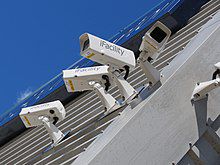
Surveillance cameras on the corner of a building.
[/span4][span4]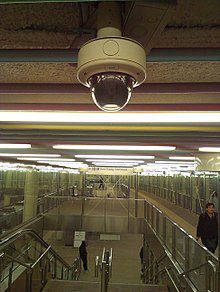
Dome camera in a rail station
[/span4][span4]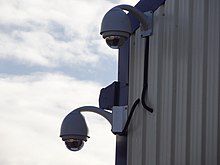
Dome CCTV cameras.
[/span4][/columns]Closed-Circuit Television (CCTV), also known as video surveillance, is the use of video cameras to transmit a signal to a specific place, on a limited set of monitors. It differs from broadcast television in that the signal is not openly transmitted, though it may employ point to point (P2P), point to multipoint (P2MP), or mesh wired or wireless links. Though almost all video cameras fit this definition, the term is most often applied to those used for surveillance in areas that may need monitoring such as banks, stores, and other areas where security is needed. Though Videotelephony is seldom called “CCTV” one exception is the use of video in distance education, where it is an important tool.
Surveillance of the public using CCTV is common in many areas around the world. In recent years, the use of body worn video cameras has been introduced as a new form of surveillance, often used in law enforcement, with cameras located on a police officer’s chest or head.[5] Video surveillance has generated significant debate about balancing its use with individuals’ right to privacy even when in public.
In industrial plants, CCTV equipment may be used to observe parts of a process from a central control room, for example when the environment is not suitable for humans. CCTV systems may operate continuously or only as required to monitor a particular event. A more advanced form of CCTV, utilizing digital video recorders (DVRs), provides recording for possibly many years, with a variety of quality and performance options and extra features (such as motion detection and email alerts). More recently, decentralized IP cameras, some equipped with megapixel sensors, support recording directly to network-attached storage devices, or internal flash for completely stand-alone operation.
There are about 350 million surveillance cameras worldwide as of 2016. About 65% of these cameras are installed in Asia. The growth of CCTV has been slowing in recent years.
😍 Liên hệ ngay với chúng tôi để nhận được tư vấn và hỗ trợ tốt nhất! 😍
Bắc Ninh Media
📞 Hotline: 0917658468 - 0222 6536789 - 0946748285
🌐 Website: https://bacninhmedia.com
🔗 Facebook: https://facebook.com/cameraquansatbacninh99
Bài viết liên quan
Dịch vụ Lắp đặt hệ thống kiểm soát truy câp Tin tức cập nhật
Top những loại khóa điện tử giá rẻ, chất lượng bắt kịp xu thế
Hiện nay, khóa cửa điện tử giá rẻ đang là một sản phẩm vô cùng hot và được nhiều...
Dịch vụ Giải pháp Lắp đặt hệ thống mạng nội bộ Tin tức cập nhật
Thi công lắp đặt mạng LAN tại Huyện Gia Bình, Bắc Ninh
Thi công lắp đặt mạng LAN tại Huyện Gia Bình, Bắc Ninh Bắc Ninh Media chúng tôi chuyên...
Giải pháp Tin tức cập nhật
Lắp đặt camera giám sát tại Bắc Ninh và các khu vực lân cận
Lắp đặt camera giám sát tại Bắc Ninh và các khu vực lân cận Bắc Ninh là tỉnh...
Dịch vụ Lắp đặt camera quan sát Tin tức cập nhật
Xem lại file lưu trữ camera trên máy tính đơn giản
Thông thường chúng ta thường xem lại camera trên chính đầu ghi camera. Việc xem này có nhiều...
Tin tức cập nhật
Hệ Thống PA System – Âm Thanh Cảnh Báo Cho Nhà Xưởng Chuẩn Phòng Cháy Chữa Cháy
Với hàng loạt khu công nghiệp lớn như VSIP, Yên Phong, Quế Võ, Thuận Thành, nhà xưởng tại...
Dịch vụ Lắp đặt hệ thống kiểm soát truy câp Tin tức cập nhật
Lắp đặt và sử dụng chuông cửa tự động như thế nào?
Bắc Ninh Media thời gian vừa qua nhận được rất nhiều câu hỏi về chuông cửa tự động,...
Giải pháp
Camera giám sát dùng smartphone Android quản lí
Với một chiếc điện thoại sử dụng hệ điều hành Android có kết nối Internet là bạn có thể ghi...
Công nghệ Dịch vụ Lắp đặt cửa từ cổng dò Tin tức cập nhật
Điểm qua những hãng chuông cửa không dây tốt nhất
Trên thị trường hiện nay các thiết bị thông minh hỗ trợ các gia đình về an ninh...
Tin tức cập nhật
Cập nhật dự án thi công lắp đặt hệ thống camera quan sát tại Phật Tích Bắc Ninh
Các dự án của chúng tôi liên tục được cập nhật trên website để giúp quý khách hàng...